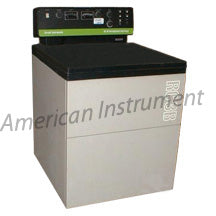
Sorvall RC-3B Refrigerated Floor Centrifuge Service, Repair & Upgrade Support
The Sorvall RC-3B is a legacy large-capacity refrigerated floor centrifuge designed for clinical laboratories, blood banks, biotechnology companies, universities, research institutions, and industrial laboratories requiring dependable low-speed centrifugation of relatively large sample volumes.
Unlike the later Sorvall RC-5 and Evolution RC high-speed floor centrifuges, the RC-3B was built around high-capacity, low-speed refrigerated processing. The centrifuge provides a speed range of approximately 150 to 6,000 rpm, supports multiple swinging-bucket rotor configurations, and can accommodate up to 6 × 1,000 mL with appropriate rotor hardware.
This makes the RC-3B particularly useful for workflows involving liters of material rather than small tubes.
With compatible H-6000A, HBB-6, or HLR-6 swinging-bucket rotors, the platform can be used for large-volume bottle processing, blood-bag applications, clinical sample preparation, cell harvesting, biomass separation, and other laboratory procedures requiring substantial capacity with controlled refrigeration.
The RC-3B also provides a temperature range of approximately -20°C to +40°C, allowing laboratories to maintain temperature-sensitive samples during extended centrifugation runs.
Its heavy floor-model construction, armored safety systems, programmed acceleration and braking, refrigerated chamber, and broad rotor compatibility helped make the RC-3B an industry standard for many years.
Many RC-3B centrifuges remain useful because they were built as durable, serviceable machines and because laboratories may still have significant investments in compatible rotors, buckets, adapters, bottles, and blood-processing accessories.
American Instrument Exchange provides repair and technical support for legacy Sorvall centrifuges, including the RC-3B and other discontinued large-capacity refrigerated floor models.
When continued repair no longer provides good long-term value, the Thermo Scientific Sorvall RC BIOS 6 provides a particularly logical modern upgrade for laboratories that still require approximately six liters of large-volume refrigerated centrifugation capacity.
Common Sorvall RC-3B Problems
The RC-3B is a durable centrifuge, but decades of service can eventually affect its drive, refrigeration, braking, electrical, control, and safety systems.
Common Sorvall RC-3B service issues can include:
-
Centrifuge will not start or accelerate normally
-
Failure to reach the selected rotor speed
-
Speed instability during operation
-
Excessive vibration or imbalance conditions
-
Unusual drive, bearing, or mechanical noise
-
Acceleration or braking problems
-
Refrigeration system not reaching the selected temperature
-
Excessive chamber temperature during a run
-
Compressor or other refrigeration-system problems
-
Temperature-control or sensor problems
-
Timer or speed-control failures
-
Electrical component failures
-
Door latch or interlock problems
-
Safety-system faults
-
Rotor or bucket wear
-
Increasing difficulty sourcing certain model-specific parts
Not every RC-3B problem means the centrifuge needs to be replaced.
A sensor, electrical component, refrigeration component, switch, interlock, timer, control, or other serviceable assembly may be responsible for the problem.
Proper diagnosis is particularly important with a legacy floor centrifuge because it can distinguish an isolated repair from deterioration involving several major systems.
Is Your Sorvall RC-3B Still Worth Repairing?
In many cases, yes.
The RC-3B was engineered as a heavy-duty laboratory centrifuge, and a mechanically sound unit may continue to provide useful service following appropriate maintenance or repair.
An isolated refrigeration, control, electrical, interlock, braking, sensor, or mechanical problem can be significantly less expensive to correct than replacing the entire centrifuge.
Existing rotor inventory can make repair even more attractive.
A laboratory that has operated an RC-3B for many years may own an H-6000A, HBB-6, HLR-6, buckets, adapters, 1-liter bottles, blood-bag accessories, or other rotor hardware built around established procedures.
That equipment can represent a substantial investment.
Keeping an otherwise sound RC-3B operational may therefore preserve considerably more than the value of the centrifuge itself.
The calculation changes when an RC-3B begins experiencing repeated drive problems, major refrigeration failures, recurring electrical problems, unreliable braking, deteriorating safety systems, or failures involving components that have become difficult to source.
At that point, laboratories should consider the total cost of continued ownership, including downtime and the operational consequences of an unexpected centrifuge failure.
American Instrument Exchange can evaluate an existing Sorvall RC-3B and help determine whether continued repair remains practical or whether transitioning to a newer large-capacity refrigerated centrifuge represents the better long-term investment.
Sorvall RC-3B Repair & Preventative Maintenance
American Instrument Exchange has extensive experience repairing, refurbishing, and testing Sorvall and Thermo Scientific centrifuges, including discontinued large-capacity floor models that may no longer receive the same level of manufacturer support as current centrifuges.
RC-3B service may include:
-
Drive motor and drive-system troubleshooting
-
Speed-control diagnostics
-
Acceleration and braking troubleshooting
-
Vibration and imbalance diagnosis
-
Refrigeration-system diagnostics and repair
-
Compressor and temperature-control evaluation
-
Temperature sensor troubleshooting
-
Timer and control-system diagnostics
-
Door latch and interlock repair
-
Electrical troubleshooting
-
Safety-system evaluation
-
Preventative maintenance
-
Operational testing with compatible rotors
Preventative maintenance can be particularly valuable with an older large-capacity centrifuge.
Speed performance, temperature control, braking, door-interlock operation, rotor condition, bucket condition, vibration, and other critical functions should be evaluated periodically rather than waiting for an obvious failure.
For an RC-3B that continues to perform reliably, preventative maintenance can help identify developing problems before they interrupt routine clinical, blood-processing, or research workflows.
What About My Existing Sorvall RC-3B Rotors?
Rotor inventory is one of the most important factors when deciding whether to repair or replace an RC-3B.
The platform was designed for several large-capacity swinging-bucket rotors, including the H-6000A, HBB-6, and HLR-6.
These rotors share a six-place architecture and were designed specifically for large-volume applications.
The H-6000A can accommodate six large bottles containing up to approximately 1,000 mL each, providing a total nominal sample capacity of approximately 6 liters.
It can also be configured with reducing adapters for smaller tubes and bottles, allowing the same rotor to support a wide range of sample formats.
The HBB-6 and HLR-6 were designed around blood-processing workflows and can accommodate appropriate blood-bag sets and accessories.
At maximum rated speed, these rotor families can generate centrifugal force exceeding approximately 7,000 × g, depending on rotor configuration.
That combination of capacity, swinging-bucket geometry, and refrigeration is what made the RC-3B valuable.
A laboratory using an RC-3B for large-volume processing should therefore avoid selecting a replacement based only on maximum speed.
A newer centrifuge that reaches 15,000 or 20,000 rpm may still be a poor replacement if it cannot accommodate the same six-liter sample load.
Rotor condition must also be evaluated independently.
Corrosion, scratches, mechanical damage, chemical exposure, bucket wear, pivot wear, fatigue, or an uncertain service history can affect whether an older rotor remains appropriate for continued operation.
Physical compatibility alone should never be considered proof that a legacy rotor is safe to operate.
Large-Volume Low-Speed Centrifugation
The RC-3B occupies a different role from many modern high-speed floor centrifuges.
Its value comes from capacity rather than extreme speed.
For laboratories processing several liters of material at a time, this distinction matters.
Large-volume centrifugation is useful for applications such as cell harvesting, fermentation harvest, microbial biomass collection, blood-component separation, plasma-processing workflows, clinical specimen preparation, large-volume clarification, and other procedures where throughput depends on how much material can be processed per run.
In these workflows, replacing the RC-3B with a smaller centrifuge may create an unexpected bottleneck.
A protocol that previously required one six-liter run might suddenly require two or three separate centrifugation cycles.
That increases operator time, delays downstream processing, and can complicate workflow scheduling.
For that reason, a true RC-3B upgrade should preserve large-volume capacity first, while improving reliability, controls, safety, and performance.
When It Makes Sense to Upgrade Your Sorvall RC-3B
A functioning RC-3B does not need to be replaced simply because it is old.
If the drive system remains healthy, refrigeration performance is stable, controls operate reliably, and repair requirements remain modest, continued operation may still provide excellent value.
Replacement becomes more compelling when the centrifuge develops repeated drive failures, major refrigeration problems, recurring electrical issues, unreliable braking, deteriorating safety systems, difficult-to-source components, or increasingly frequent service requirements.
Laboratory workflow can also change over time.
A laboratory that once required six liters of capacity may now process smaller batches. In that case, transitioning to a smaller modern refrigerated centrifuge may provide greater speed, flexibility, and lower operating cost.
But if the laboratory still depends on six-liter batch processing, downsizing simply because the RC-3B is old can create more problems than it solves.
The replacement should be chosen around the actual workload.
Thermo Scientific Sorvall RC BIOS 6: The Natural Large-Capacity Upgrade
For laboratories that still require the RC-3B's six-liter workflow, the Thermo Scientific Sorvall RC BIOS 6 is one of the most logical modern successors.
The RC BIOS 6 is a large-capacity refrigerated centrifuge designed specifically for high-throughput bioprocessing and large-volume laboratory applications.
With appropriate rotor configuration, the platform can accommodate 6 × 1,000 mL, preserving the fundamental six-liter processing capacity that made the RC-3B useful.
At the same time, the RC BIOS 6 provides substantially greater performance, with speeds up to approximately 8,500 rpm and centrifugal forces approaching 15,860 × g, depending on rotor configuration.
This gives laboratories considerably more separation capability without sacrificing large-volume throughput.
The modern platform also incorporates newer drive technology, programmable acceleration and deceleration, advanced controls, improved run management, and safety systems designed around contemporary laboratory requirements.
For a laboratory that currently uses an RC-3B with an H-6000A rotor for six-liter bottle processing, the RC BIOS 6 therefore represents a much more logical upgrade than moving to a high-speed floor centrifuge designed primarily for smaller-volume rotors.
The objective is not simply to buy something newer.
It is to preserve the workflow while improving performance, reliability, controls, and long-term supportability.
What If Your Laboratory No Longer Needs Six-Liter Capacity?
Not every RC-3B owner still needs a six-liter centrifuge.
Laboratory workflows change.
A facility that once processed large blood-bag loads or multiple one-liter bottles may now work primarily with 50 mL conical tubes, 250 mL bottles, microplates, or smaller-volume cell culture samples.
In that situation, replacing the RC-3B with another six-liter floor centrifuge may be unnecessary.
A modern refrigerated benchtop or smaller floor centrifuge could provide substantially greater speed and RCF while reducing footprint and potentially simplifying installation.
American Instrument Exchange can help compare replacement options based on actual sample formats rather than assuming that every RC-3B must be replaced with another large floor centrifuge.
The important question is:
What does your laboratory need to centrifuge today?
That answer should determine the replacement platform.
Electrical, Space & Installation Considerations
The RC-3B is a substantial piece of equipment.
The centrifuge measures approximately 48"H × 30"W × 40"D and weighs approximately 685 pounds.
Electrical configurations can vary, but many units operate on approximately 230V, 50/60Hz service.
Replacing a floor-model centrifuge should therefore include more than a comparison of speed and capacity.
Available floor space, electrical service, doorway width, corridor access, freight elevator capacity, loading-dock access, and the physical route into and out of the laboratory should all be considered before delivery.
Large centrifuges also require sufficient clearance for ventilation, lid access, and routine maintenance.
American Instrument Exchange can help laboratories evaluate these practical installation considerations when selecting a refurbished replacement.
Why Choose American Instrument Exchange?
American Instrument Exchange has decades of experience repairing, refurbishing, testing, and supplying centrifuges for biotechnology companies, pharmaceutical manufacturers, hospitals, universities, blood centers, research laboratories, and other organizations.
Our experience with legacy Sorvall centrifuges is particularly valuable when evaluating an RC-3B.
Because we both repair existing centrifuges and supply professionally refurbished replacement equipment, replacement does not have to be the automatic recommendation.
If a practical repair can restore an otherwise sound RC-3B to dependable operation, continuing to use the existing centrifuge—and potentially preserving the laboratory's investment in H-6000A, HBB-6, HLR-6, buckets, bottles, and adapters—may provide excellent value.
If repeated drive, refrigeration, electrical, or safety-related failures make continued operation increasingly difficult to justify, we can also help transition the laboratory to a modern replacement selected around the actual application.
For laboratories that still need true six-liter refrigerated centrifugation, the Thermo Scientific Sorvall RC BIOS 6 provides a particularly strong upgrade path.
Professionally refurbished centrifuges supplied by American Instrument Exchange are inspected, serviced as necessary, and tested for proper speed, refrigeration, controls, braking, safety functions, and overall operation before shipment.
When supplied with a rotor, the centrifuge and rotor combination is tested together.
Refurbished equipment is backed by a 90-day warranty.
Frequently Asked Questions
Can a Sorvall RC-3B centrifuge still be repaired?
Yes. Many Sorvall RC-3B centrifuges remain repairable. Whether a particular unit is worth repairing depends on the nature of the problem, condition of the drive and refrigeration systems, parts availability, rotor condition, previous repair history, and overall mechanical condition.
What is the speed range of the Sorvall RC-3B?
The RC-3B operates over a speed range of approximately 150 to 6,000 rpm. Maximum operating speed depends on the rotor installed.
What is the maximum capacity of the Sorvall RC-3B?
With a compatible H-6000A swinging-bucket rotor, the RC-3B can accommodate 6 × 1,000 mL, providing approximately 6 liters of total nominal capacity.
What is the temperature range of the Sorvall RC-3B?
The RC-3B provides refrigerated operation over an approximate temperature range of -20°C to +40°C.
What rotors can be used with the Sorvall RC-3B?
The RC-3B supports multiple legacy Sorvall rotors. Common large-capacity options include the H-6000A, HBB-6, and HLR-6 swinging-bucket rotors.
The exact maximum speed, RCF, capacity, and sample configuration depend on the rotor installed.
What is the capacity of the H-6000A rotor?
The H-6000A is a six-place swinging-bucket rotor capable of accommodating six bottles with up to approximately 1,000 mL of sample each, providing approximately 6 liters of total capacity.
Reducing adapters can also accommodate numerous smaller tube and bottle formats.
Why is my Sorvall RC-3B vibrating?
Vibration can result from improperly balanced samples, uneven bucket loading, rotor or bucket problems, worn mechanical components, drive-system issues, or other conditions.
Because of the mass involved in a fully loaded large-capacity rotor, persistent or unusual vibration should be investigated before continuing to operate the centrifuge.
Why is my RC-3B not cooling properly?
Poor refrigeration performance can result from compressor problems, refrigerant loss, condenser issues, temperature-control failures, sensor problems, electrical faults, or other refrigeration-system conditions.
Proper diagnosis can determine whether the problem represents a practical repair.
Why is my RC-3B not reaching speed?
Failure to reach programmed speed may be associated with drive-system problems, speed-control electronics, electrical faults, excessive or improper loading, rotor issues, or mechanical problems.
The centrifuge and installed rotor should be evaluated together.
Are Sorvall RC-3B parts still available?
Parts availability varies by component.
Some refrigeration, electrical, mechanical, and service components may remain repairable or replaceable, while proprietary and model-specific parts can become increasingly difficult to source.
American Instrument Exchange can evaluate the specific failure and determine what repair options remain available.
When should I replace my Sorvall RC-3B instead of repairing it?
Replacement should be considered when the centrifuge develops repeated drive or refrigeration failures, recurring electrical problems, unreliable braking, deteriorating safety systems, difficult-to-source components, or increasing downtime.
Changes in workflow should also be considered. If the laboratory no longer requires six-liter capacity, a smaller modern centrifuge may be a better fit.
What is the best modern replacement for a Sorvall RC-3B?
For laboratories that still require approximately six liters of large-volume refrigerated centrifugation capacity, the Thermo Scientific Sorvall RC BIOS 6 is a particularly logical modern upgrade.
It preserves 6 × 1,000 mL processing capability while providing substantially greater speed, RCF, modern controls, and contemporary safety features.
Should I replace an RC-3B with a Thermo Lynx centrifuge?
Not automatically.
The Lynx family is an excellent modern high-speed floor centrifuge platform, but the RC-3B was primarily designed around large-volume, low-speed six-liter processing.
If preserving six-liter throughput is important, a large-capacity platform such as the RC BIOS 6 is generally a more natural match.
If your current workflow uses much smaller sample volumes, a Lynx or another modern centrifuge may make sense.
Does American Instrument Exchange repair Sorvall RC-3B centrifuges?
Yes. American Instrument Exchange provides repair and technical support for legacy Sorvall centrifuges, including the RC-3B and other discontinued refrigerated floor models.
We can evaluate an existing centrifuge and help determine whether repair or replacement represents the more practical long-term solution.
Schedule Sorvall RC-3B Service or Discuss Replacement Options
If your Sorvall RC-3B is experiencing drive problems, vibration, speed-control issues, refrigeration problems, braking problems, electrical failures, door-interlock problems, or other performance concerns, American Instrument Exchange can help diagnose the problem and determine whether repair remains practical.
If continued repairs no longer provide good long-term value, we can also help determine whether the Thermo Scientific Sorvall RC BIOS 6 or another modern refrigerated centrifuge provides the best replacement based on your sample volumes and laboratory workflow.
Contact American Instrument Exchange to discuss Sorvall RC-3B repair, RC3B troubleshooting, H-6000A rotor applications, six-liter refrigerated centrifuge service, blood-processing centrifuge repair, preventative maintenance, or modern large-capacity centrifuge replacement options.