
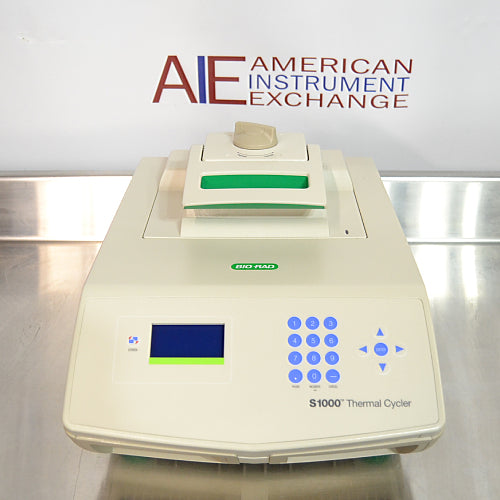


Bio-Rad S1000 Thermal Cycler with 96-Deep Well Reaction Module
Shipping
All products ship from our 30,000 sq. ft. Haverhill, MA warehouse
Shipping
All products ship from our 30,000 sq. ft. Haverhill, MA warehouse
The Bio-Rad S1000 Thermal Cycler with 96-Deep Well Reaction Module is a versatile gradient PCR system designed for conventional DNA amplification, assay optimization, cloning, genotyping, mutagenesis, sequencing workflows, gene-expression research, and other molecular biology applications. Combining Bio-Rad's modular S1000 thermal cycler chassis with a gradient-enabled 96-deep well reaction module, this system provides laboratories with flexible sample compatibility, precise Peltier temperature control, programmable thermal gradients, extensive protocol storage, and reliable performance for routine and research PCR.
The 96-Deep Well module accommodates 96 x 0.2 mL PCR tubes, 48 x 0.5 mL tubes, or one compatible 96-well PCR plate, making it particularly useful for laboratories that need greater vessel flexibility than a standard fast 96-well block. The module provides a 0°C to 100°C temperature range, maximum ramp rate of approximately 2.5°C/sec, temperature accuracy of ±0.2°C at 90°C, and well-to-well temperature uniformity of ±0.4°C within 10 seconds of reaching 90°C.
A programmable thermal gradient from 30°C to 100°C, with a selectable temperature differential of 1°C to 24°C, allows researchers to test multiple annealing temperatures within a single run. This can significantly simplify optimization of new primers and PCR assays.
The S1000 can operate as a standalone thermal cycler or as part of a larger Bio-Rad 1000-Series system controlled by a compatible C1000 or C1000 Touch thermal cycler. More than 1,000 typical PCR protocols can be stored onboard, making the system practical for laboratories running numerous established methods.
This Bio-Rad S1000 is available used and refurbished from American Instrument Exchange. AIE technicians inspect, clean, test, and verify major instrument functions prior to shipment, and the system includes a 90-day warranty from American Instrument Exchange.
Bio-Rad S1000 Thermal Cycler
96-Deep Well gradient reaction module
Supports 96 x 0.2 mL PCR tubes
Supports 48 x 0.5 mL tubes
Supports one 96-well PCR plate
Temperature range of 0°C to 100°C
Maximum ramp rate of approximately 2.5°C/sec
Average ramp rate of approximately 2°C/sec
Temperature accuracy of ±0.2°C at 90°C
Well-to-well uniformity of ±0.4°C
Programmable thermal gradient
Gradient range of 30°C to 100°C
Gradient differential of 1°C to 24°C
Peltier-based heating and cooling
Adjustable heated lid
Calculated and block temperature-control modes
LCD interface
Text-based programming
More than 1,000 typical programs stored onboard
Instant incubation function
Four USB-A ports and one USB-B port
Compatible with C1000 and C1000 Touch system control
Interchangeable reaction-module architecture
Suitable for conventional endpoint PCR
Used and refurbished by American Instrument Exchange
90-day AIE warranty
Polymerase chain reaction requires precise and repeatable control of temperature as samples move through repeated denaturation, annealing, and extension steps.
Small differences in thermal performance can affect amplification efficiency, specificity, and reproducibility.
The Bio-Rad S1000 was designed as a modular PCR platform capable of supporting several interchangeable reaction modules while maintaining consistent Peltier-based temperature control.
This configuration includes the 96-Deep Well module, which offers greater vessel flexibility than Bio-Rad's standard 96-well fast block.
The system can be used as a standalone conventional thermal cycler or integrated into a larger multi-instrument Bio-Rad workflow.
| Specification | Details |
|---|---|
| Manufacturer | Bio-Rad |
| Model | S1000 |
| Equipment Type | Conventional PCR Thermal Cycler |
| Reaction Module | 96-Deep Well, Gradient Enabled |
| Sample Capacity | 96 x 0.2 mL tubes |
| Alternate Sample Capacity | 48 x 0.5 mL tubes |
| Plate Capacity | 1 x 96-well PCR plate |
| Temperature Range | 0°C to 100°C |
| Maximum Ramp Rate | 2.5°C/sec |
| Average Ramp Rate | Approx. 2°C/sec |
| Temperature Accuracy | ±0.2°C of programmed target at 90°C |
| Temperature Uniformity | ±0.4°C well-to-well within 10 sec of reaching 90°C |
| Gradient Capability | Yes |
| Gradient Range | 30°C to 100°C |
| Gradient Differential | 1°C to 24°C |
| Temperature Control Modes | Calculated and block |
| Display | LCD |
| Programming | Text based |
| Protocol Memory | More than 1,000 typical programs |
| Heated Lid | Fully adjustable |
| Ports | 4 USB-A, 1 USB-B |
| Instant Incubation | Yes |
| Dimensions | Approx. 13"W x 18"D x 8"H, chassis |
| Manufacturer Weight | Approx. 23 lb. |
| Input Power | Up to 700 W maximum |
| Frequency | 50–60 Hz, single phase |
| Condition | Used / Refurbished |
| AIE Warranty | 90 Days |
The Bio-Rad S1000 is well suited for conventional PCR amplification, cloning, genotyping, mutagenesis, cycle sequencing, gene-expression research, assay development, primer optimization, molecular screening, sequencing preparation, and general nucleic-acid research.
Its programmable gradient capability makes it particularly useful for laboratories developing new PCR methods or troubleshooting amplification conditions.
The S1000 is a practical choice for biotechnology companies, pharmaceutical research laboratories, academic molecular biology laboratories, genomics facilities, university core facilities, contract research organizations, agricultural biotechnology laboratories, forensic research groups, and other facilities performing conventional PCR.
Its modular architecture also makes it useful in laboratories that already operate Bio-Rad C1000 or C1000 Touch systems and want to expand thermal-cycling capacity.
The 96-Deep Well module distinguishes this S1000 configuration from Bio-Rad's standard 96-Well Fast module.
It accommodates:
96 x 0.2 mL PCR tubes
48 x 0.5 mL tubes
or
one compatible 96-well PCR plate.
This expanded vessel compatibility can be useful for laboratories that perform a mixture of routine plate-based PCR and individual tube-based protocols.
Many PCR thermal cyclers are optimized primarily around 0.2 mL tubes and standard PCR plates.
The S1000 Deep Well module provides additional flexibility by accommodating 0.5 mL tubes.
This can be useful for laboratories working with larger reaction volumes or legacy protocols that still use larger PCR vessels.
It also allows a single thermal cycler to support several common reaction formats without changing the entire instrument.
The S1000 uses Peltier technology to heat and cool the reaction block.
Peltier systems allow rapid changes between programmed temperatures without the compressors or circulating fluids associated with older thermal-control technologies.
During a PCR run, the system repeatedly moves among temperatures used for:
Denaturation
Annealing
Extension
Final extension
and
Hold steps.
Precise electronic control helps maintain reproducible conditions through dozens of thermal cycles.
The reaction module operates across a broad:
0°C to 100°C
temperature range.
This supports conventional PCR protocols as well as specialized incubation and hold steps.
Typical PCR programs may include:
94–98°C denaturation
50–65°C annealing
68–72°C extension
4°C final hold
Actual parameters should always be selected according to primers, polymerase, DNA template, amplicon length, and assay design.
Bio-Rad specifies temperature accuracy of:
±0.2°C of the programmed target at 90°C.
Accurate block temperature can help improve transferability of established protocols between runs and between compatible instruments.
This is particularly important when laboratories use tightly optimized annealing temperatures.
Well-to-well temperature uniformity is specified at:
±0.4°C within 10 seconds of arrival at 90°C.
Uniform block temperature helps ensure that samples positioned in different areas of the plate experience similar thermal conditions.
This can reduce one source of variation in multi-sample PCR experiments.
The 96-Deep Well module provides a maximum ramp rate of approximately:
2.5°C/sec
with an average ramp rate of approximately:
2°C/sec.
Although Bio-Rad's 96-Well Fast module can ramp more quickly, the Deep Well module prioritizes compatibility with multiple vessel formats.
For laboratories using 0.5 mL tubes or requiring the deeper block geometry, the tradeoff can be worthwhile.
The S1000 Deep Well module includes built-in gradient capability.
The gradient can be programmed across a range of:
30°C to 100°C
with a temperature differential between approximately:
1°C and 24°C.
This makes it possible to expose different rows of samples to different temperatures during the same PCR run.
Finding the correct annealing temperature is one of the most important steps in PCR optimization.
If the temperature is too low, primers may bind nonspecifically.
If the temperature is too high, amplification efficiency may decline.
A thermal gradient allows researchers to test several conditions simultaneously rather than running multiple separate experiments.
For example, researchers developing a new primer pair can evaluate several annealing temperatures within a single plate and then select the condition producing the strongest specific amplification.
Gradient capability can accelerate:
Primer optimization
New assay development
Troubleshooting
Mutagenesis protocols
Genotyping assays
Cloning workflows
Research PCR development
This makes the S1000 useful not only for established PCR protocols but also for laboratories frequently developing new assays.
The S1000 includes a fully adjustable heated lid designed to accommodate a variety of PCR vessels.
The heated lid helps reduce condensation on caps and plate seals during cycling.
Without adequate lid heating, water can condense at the top of the reaction vessel, altering the effective reaction volume.
Modern heated-lid systems generally eliminate the need for mineral-oil overlays that were common with older PCR instruments.
The S1000 offers both:
Calculated temperature control
and
Block temperature control.
Calculated control estimates sample temperature based on thermal behavior rather than relying only on the physical block temperature.
This can help compensate for differences between the block and the actual reaction mixture during rapid temperature transitions.
Block-control mode regulates the system according to the measured temperature of the reaction block itself.
This mode may be useful when transferring protocols from older thermal cyclers or when a method was originally validated using block-based control.
Having both modes provides additional flexibility when reproducing established PCR protocols.
The S1000 can store more than:
1,000 typical PCR programs
in onboard memory.
This is particularly useful in shared research laboratories where many different protocols are used.
Researchers can save established methods instead of re-entering:
Temperature steps
Cycle counts
Gradient settings
Extension times
and
Hold parameters
for each experiment.
The S1000 uses an LCD display with text-based programming.
Although simpler than the touchscreen interface used on newer Bio-Rad systems, the controller provides direct access to protocol creation and execution without requiring a dedicated computer for routine standalone operation.
The S1000 includes an instant-incubation function.
This allows the thermal block to be held at a selected temperature without programming a complete PCR cycling protocol.
Potential uses include:
Sample incubation
Enzyme reactions
DNA denaturation
Temperature-controlled holds
Post-PCR incubation
This increases the utility of the instrument beyond conventional cycling alone.
One of the major advantages of Bio-Rad's 1000-Series architecture is its interchangeable reaction-module design.
The S1000 platform was offered with several modules, including:
96-Well Fast
96-Deep Well
Dual 48/48-Well Fast
384-Well
All are gradient capable.
This modular approach allowed laboratories to configure the platform according to sample format and throughput requirements.
The 96-Well Fast module provides:
96 x 0.2 mL positions
and a faster maximum ramp rate of approximately:
5°C/sec.
The 96-Deep Well configuration provides:
96 x 0.2 mL tubes
48 x 0.5 mL tubes
or
one 96-well plate
with a maximum ramp rate of approximately:
2.5°C/sec.
The Deep Well module is therefore better suited for laboratories that value vessel flexibility, while the Fast module is preferable when maximum cycling speed is the primary requirement.
The Dual 48/48 Fast Reaction Module contains two independently controlled 48-well blocks.
That configuration allows two different PCR protocols to run simultaneously.
The 96-Deep Well configuration instead provides one unified 96-position thermal environment with compatibility for larger 0.5 mL tubes.
The appropriate configuration depends on whether the laboratory prioritizes:
Independent simultaneous protocols
or
Broader vessel compatibility.
The 384-well module is optimized for higher throughput and smaller reaction formats.
It accommodates one 384-well PCR plate.
The 96-Deep Well module is better suited for routine PCR and laboratories that require compatibility with individual 0.2 mL and 0.5 mL tubes.
The S1000 can operate independently as a conventional PCR thermal cycler.
This makes it useful for laboratories that simply need reliable PCR amplification without requiring a larger networked system.
Researchers can program and run PCR methods directly on the instrument.
The S1000 can also function as part of a larger Bio-Rad 1000-Series thermal-cycling system.
When connected to a compatible C1000 or C1000 Touch thermal cycler, multiple S1000 units can be controlled within a larger multi-bay configuration.
Bio-Rad documentation describes networked configurations of up to:
32 systems
under appropriate PC-controlled setups.
This can provide considerable PCR capacity for high-throughput molecular biology laboratories.
The S1000 in this configuration is a conventional endpoint PCR thermal cycler.
It controls temperature but does not contain the optical fluorescence-detection system required for real-time PCR.
It is therefore ideal for workflows where amplified DNA is subsequently analyzed using techniques such as:
Gel electrophoresis
Fragment analysis
Sequencing
Restriction analysis
Cloning
Other downstream molecular methods.
Researchers requiring quantitative real-time amplification measurements should use a dedicated qPCR system such as an appropriate Bio-Rad CFX platform.
Conventional PCR answers a basic question:
Was the desired DNA target successfully amplified?
Real-time PCR or qPCR additionally measures fluorescence during amplification and can provide quantitative information.
The Bio-Rad S1000 is designed primarily for conventional thermal cycling.
This makes it appropriate for cloning, genotyping, assay development, sequencing preparation, and many other workflows where real-time fluorescence detection is unnecessary.
PCR is central to many molecular cloning workflows.
The S1000 can support:
Insert amplification
Vector verification
Colony PCR
Construct confirmation
Site-directed mutagenesis
Sequence preparation
Its gradient capability can be particularly helpful when developing new amplification protocols for unfamiliar primer sets.
The S1000 can be used for conventional PCR-based genotyping.
Typical applications may include:
Transgenic screening
Gene-editing confirmation
SNP-related assays
Animal-model genotyping
Plant-genetics research
Research cohort screening
The 96-position format provides practical throughput for routine genotyping laboratories.
Site-directed mutagenesis protocols frequently rely on precisely controlled PCR amplification.
The S1000's programmable temperature control and gradient capability can help optimize amplification when introducing specific sequence changes.
Bio-Rad also identifies cycle sequencing as an application for the S1000 platform.
Cycle-sequencing reactions use repeated temperature cycles in a manner similar to PCR, allowing the thermal cycler to support appropriate sequencing workflows.
Although the S1000 does not itself perform real-time gene-expression quantification, it can be used during supporting molecular biology workflows involving amplification, cloning, assay development, and sequencing preparation.
Quantitative expression analysis requiring fluorescence monitoring should be performed on a qPCR platform.
Biotechnology and pharmaceutical research laboratories can use the S1000 for:
Molecular cloning
Assay development
Genotyping
DNA amplification
Mutagenesis
Sequencing preparation
Biomarker research
Research screening
The instrument's combination of gradient optimization and programmable cycling makes it useful during both early assay development and routine research.
The S1000 is particularly well suited for academic laboratories because one system can support many different PCR workflows.
Researchers can save large numbers of protocols while the gradient capability allows students and investigators to optimize new assays without consuming multiple instruments.
The straightforward LCD interface and conventional 96-well architecture also make the S1000 suitable for educational and teaching laboratories.
Students can learn fundamental PCR concepts including:
Denaturation
Annealing
Extension
Thermal gradients
Cycle numbers
Primer optimization
without requiring a more complex real-time PCR system.
Bio-Rad's 1000-Series reaction modules support appropriate PCR consumables according to module geometry.
For the 96-Deep Well version, users can operate compatible:
0.2 mL tubes
0.5 mL tubes
and
96-well PCR plates.
Correct vessel selection and good thermal contact with the block remain important for consistent results.
PCR plates and tubes should be properly sealed before cycling.
Correct sealing helps reduce:
Evaporation
Cross-contamination
Sample-volume changes
Condensation
and
Well-to-well inconsistencies.
The heated lid further helps control condensation during high-temperature cycling.
PCR systems depend on accurate heating, cooling, timing, block performance, and electronic controls.
American Instrument Exchange tests used and refurbished laboratory equipment to confirm proper operation prior to shipment.
Evaluation of a Bio-Rad S1000 may include:
Instrument startup
LCD operation
Programming functions
Reaction-block heating
Reaction-block cooling
Temperature setpoints
Program execution
Gradient operation
Heated-lid function
Timing functions
USB interfaces
Block recognition
Electrical operation
Overall instrument condition
AIE technicians repair or replace components as necessary and thoroughly clean the instrument before shipment.
A refurbished Bio-Rad S1000 can provide dependable PCR capability at substantially lower cost than purchasing a current-generation thermal cycler new.
American Instrument Exchange supplies used and refurbished molecular biology equipment for biotechnology companies, pharmaceutical laboratories, universities, research institutions, clinical research groups, and industrial laboratories.
Available molecular biology equipment may include PCR thermal cyclers, real-time PCR systems, centrifuges, microcentrifuges, electrophoresis equipment, incubators, shakers, laboratory refrigerators, freezers, ultra-low freezers, and related laboratory instruments.
This Bio-Rad S1000 includes a 90-day warranty from American Instrument Exchange.
The S1000 chassis measures approximately:
13"W x 18"D x 8"H
and Bio-Rad lists the system weight at approximately:
23 lb.
The instrument requires a stable laboratory bench with adequate ventilation and access to appropriate electrical power.
Laboratories should also confirm they have compatible:
PCR tubes
PCR plates
Plate seals
Tube caps
and
Reaction racks
for the specific 96-Deep Well block.
Laboratories using the Bio-Rad S1000 may also require PCR workstations, clean benches for appropriate nonhazardous PCR setup workflows, microcentrifuges, benchtop centrifuges, vortex mixers, pipettes, electrophoresis equipment, gel documentation systems, laboratory refrigerators, freezers, ultra-low freezers, incubators, and real-time PCR systems.
American Instrument Exchange offers used, refurbished, and new equipment for molecular biology, biotechnology, pharmaceutical, academic, clinical research, and industrial laboratories.
The Bio-Rad S1000 is a modular conventional PCR thermal cycler designed for DNA amplification, gradient PCR, cloning, genotyping, mutagenesis, cycle sequencing, and other molecular biology applications.
This system is equipped with the 96-Deep Well Reaction Module.
It can accommodate up to 96 x 0.2 mL tubes or one compatible 96-well PCR plate.
Yes. The deep-well module can accommodate up to 48 x 0.5 mL tubes.
No. The manufacturer specifies 0.2 mL and 0.5 mL PCR tube formats, not 2 mL tubes.
The module operates from approximately 0°C to 100°C.
The maximum ramp rate for the 96-Deep Well module is approximately 2.5°C/sec.
Approximately 2°C/sec.
Bio-Rad specifies approximately ±0.2°C of the programmed target at 90°C.
Well-to-well uniformity is approximately ±0.4°C within 10 seconds after reaching 90°C.
Yes. All of Bio-Rad's primary S1000 reaction modules include gradient capability.
Approximately 30°C to 100°C.
The programmable differential can range from approximately 1°C to 24°C.
A thermal gradient allows researchers to test several annealing temperatures simultaneously, making it easier to optimize primers and new PCR protocols.
Yes. It has an adjustable heated lid designed to reduce condensation and accommodate different reaction vessels.
More than 1,000 typical protocols can be stored in onboard memory.
Yes. It can operate as a standalone thermal cycler.
Yes. Bio-Rad designed the S1000 to integrate with compatible C1000 and C1000 Touch systems for expanded thermal-cycling capacity.
No. The S1000 itself is a conventional thermal cycler and does not contain fluorescence-detection optics for qPCR.
Not directly. Quantitative real-time PCR requires an instrument with optical fluorescence detection, such as an appropriate Bio-Rad CFX system.
Yes. It is well suited for insert amplification, colony PCR, construct verification, and related cloning workflows.
Yes. Conventional PCR-based genotyping is one of the common applications for the S1000.
Yes. Its programmable thermal cycling and gradient capability can support site-directed mutagenesis and related amplification workflows.
Yes. Bio-Rad lists cycle sequencing among the applications for the S1000 platform.
The Deep Well module supports 0.2 mL and 0.5 mL tubes and has a maximum ramp rate of approximately 2.5°C/sec. The 96-Well Fast module supports 0.2 mL formats and can ramp at up to approximately 5°C/sec.
The chassis measures approximately 13"W x 18"D x 8"H.
Bio-Rad specifies approximately 23 lb. for the S1000 system.
Yes. American Instrument Exchange offers this S1000 used and refurbished.
The current AIE listing includes a 90-day warranty.
Yes, all equipment from American Instrument Exchange comes with a warranty.
Used/reconditioned/refurbished equipment is tested to make sure it operates to the manufacturer's specifications and comes with a 90-day warranty (unless otherwise noted). New equipment comes with a warranty from the manufacturer.
Testing requirements vary across all the equipment categories we sell. Temperature controlled units are tested with NIST traceable probes and data loggers. Gaskets, external housing, glass, handles, controls and control screens are all thoroughly inspected for integrity and functionality.
We test all equipment using the manufacturer's parameters and specifications to confirm that the unit operates properly.
We can ship products both nationally and internationally using a well-established network of transporters. Smaller items will ship via UPS. Larger equipment will be palletized and shipped either LTL or air-ride, depending on the specific equipment and/or delivery requirements.
American Instrument Exchange will accept the return of any product that is not working as represented and could not be replaced or repaired to the customer's satisfaction during the warranty period. Customers who cancel orders after refurbishing has begun will be subject to a cancellation and restocking fee of between 20% and 40%.
Yes – call or email us today with a list of equipment you're looking for and we can potentially put together a quote that includes a discount.
We strive to keep our pricing competitive and reasonable. If you find comparable items for sale at a lower price from other vendors please send us a link and or quote for the item and we'll do our best to match or beat the price.
Customers are welcome to make an appointment to view equipment in our warehouse. Given our workload we may not be able to test or clean the equipment prior to your arrival if you have not committed to an order.
1023 Western Avenue is a working warehouse, not a showroom, and customers should dress appropriately and wear closed toe shoes.
Yes – please see our repair services page for more information.