
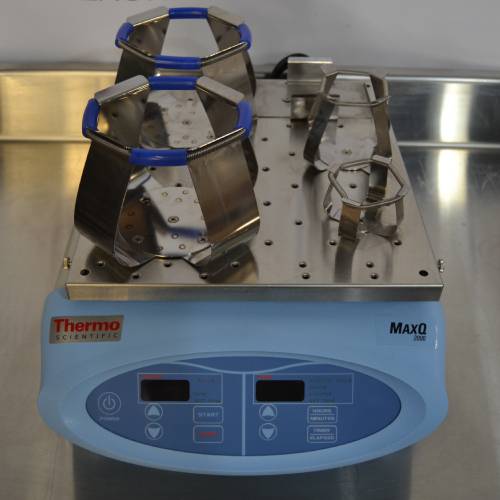


Thermo Scientific MaxQ 2000 Digital Orbital Shaker
Shipping
All products ship from our 30,000 sq. ft. Haverhill, MA warehouse
Shipping
All products ship from our 30,000 sq. ft. Haverhill, MA warehouse
The Thermo Scientific MaxQ 2000 Digital Orbital Shaker is a compact, high-capacity benchtop shaker designed for bacterial and yeast culture, recombinant protein expression, plasmid preparation, staining and destaining, extraction procedures, solubility studies, hybridization, washing, and general laboratory mixing. With a variable speed range of 15 to 500 rpm, a 19 mm orbital motion, and a maximum load capacity of 35 lb, the MaxQ 2000 provides substantial shaking performance in a relatively compact footprint.
Digital controls allow researchers to precisely set shaking speed and operating time, while separate LED displays show both parameters simultaneously. A soft-start function gradually accelerates the platform to reduce sudden movement and splashing, while an unbalanced-load sensor stops platform motion if excessive vibration is detected. Automatic restart following a power interruption helps protect long-duration cultures and experiments.
Unlike an incubated shaker, the MaxQ 2000 does not provide its own temperature control. It can operate as a room-temperature benchtop orbital shaker or be placed in a compatible incubator, warm room, environmental chamber, or refrigerator when temperature-controlled shaking is required.
This Thermo Scientific MaxQ 2000 Digital Shaker is available used and refurbished from American Instrument Exchange. The shaker is inspected, cleaned, and tested prior to shipment and includes a 90-day warranty from AIE.
Thermo Scientific MaxQ 2000 digital orbital shaker
Variable speed from 15 to 500 rpm
19 mm / 0.75-inch orbital motion
Maximum load capacity of 35 lb / 15.9 kg
Maintenance-free solid-state DC brushless motor
Digital speed and timer controls
Separate LED displays for speed and operating time
Continuous or timed operation
Soft-start function reduces abrupt acceleration and splashing
Unbalanced-load detection
Audible and visual speed alarms
Automatic restart following a power interruption
Nonvolatile parameter retention
RS-232 interface for remote monitoring
Multiple available platform sizes
Suitable for compatible incubators, warm rooms, environmental chambers, and refrigerators
Used and refurbished by American Instrument Exchange
90-day AIE warranty
The MaxQ 2000 is designed for laboratories that need reliable orbital agitation without the size or expense of an enclosed incubator shaker.
Its compact chassis can support platform loads up to 35 lb, allowing the instrument to handle anything from groups of small culture flasks to appropriately configured multi-liter vessels.
The digital MaxQ 2000 also provides several operational features that distinguish it from basic analog orbital shakers. Researchers can set and monitor speed electronically, program timed runs, monitor both speed and time on dedicated displays, and rely on built-in protection against excessive load imbalance.
For microbiology, molecular biology, biotechnology, pharmaceutical, academic, and general research laboratories, the MaxQ 2000 offers a useful combination of compact dimensions, substantial capacity, broad vessel compatibility, and straightforward digital operation.
| Specification | Details |
|---|---|
| Manufacturer | Thermo Scientific |
| Model | MaxQ 2000 |
| Equipment Type | Digital Open-Air Orbital Shaker |
| Control Type | Digital |
| Speed Range | 15–500 rpm |
| Orbit | 19 mm / 0.75 in. |
| Maximum Load | 35 lb. / 15.9 kg |
| Motor | Solid-state DC brushless |
| Timer | Continuous or timed operation |
| Timed Range | 0.1 min. to 999 min. or 0.1 hr. to 999 hr. |
| Display | Separate LED speed and time displays |
| Soft Start | Yes |
| Unbalanced Load Detection | Yes |
| Speed Alarm | Audible and visual |
| Automatic Restart | Yes |
| Remote Monitoring | RS-232 |
| Operating Temperature | 0°C to 40°C |
| Operating Humidity | 20% to 80%, non-condensing |
| Manufacturer Chassis Dimensions | 17.4 × 13.5 × 6.4 in. |
| Manufacturer Shipping Weight | Approx. 47 lb. / 21.3 kg |
| Platform Options | 13 × 11, 18 × 18, or 24 × 18 in. |
| Electrical | 120V configuration per AIE listing |
| Condition | Used / Refurbished |
| AIE Warranty | 90 Days |
The Thermo MaxQ 2000 is well suited for bacterial and yeast culture, recombinant protein expression, plasmid production, strain screening, microbial research, extraction procedures, hybridization, staining and destaining, solubility studies, washing procedures, diagnostic sample preparation, and general laboratory mixing.
Its broad speed range also allows the same shaker to support both relatively gentle agitation and vigorous microbial culture applications.
The MaxQ 2000 is an excellent fit for biotechnology companies, microbiology laboratories, molecular biology groups, pharmaceutical research facilities, protein-expression laboratories, academic research groups, fermentation and process-development laboratories, diagnostic research facilities, and industrial laboratories.
Its compact footprint is particularly useful for laboratories where bench space is limited but researchers still need meaningful flask capacity.
The digital MaxQ 2000 provides variable orbital agitation from 15 to 500 rpm.
This broad range allows researchers to tailor shaking intensity to the vessel, sample, liquid volume, organism, and experimental objective.
Lower speeds can support gentle mixing, staining, washing, and extraction procedures. Higher speeds are useful for appropriately configured microbial cultures and other applications requiring increased mixing or gas transfer.
The electronic control system provides more precise speed selection than a conventional mechanical dial and allows the user to view actual operating speed directly on the LED display.
The MaxQ 2000 uses a 19 mm / 0.75-inch orbit.
Orbit diameter influences how liquids move inside flasks and other vessels. Together with rpm, vessel geometry, and fill volume, it affects mixing intensity, oxygen transfer, and shear.
The 19 mm orbit is well suited to a broad range of routine laboratory applications, particularly microbial shake-flask culture.
When transferring an established protocol from another shaker, both rpm and orbit diameter should be considered. Two shakers operating at the same rpm can produce different mixing conditions when their orbital diameters differ.
Despite its relatively compact size, the MaxQ 2000 supports platform loads up to 35 lb / 15.9 kg.
This allows the shaker to handle multiple filled culture vessels or larger flask configurations without requiring a floor-standing shaker.
Actual operating capacity depends on the platform, clamps, vessel sizes, total load, load distribution, and selected shaking speed.
Balanced loading is important for smooth operation. Flasks and other vessels should be distributed as evenly as practical across the platform.
Thermo designed the MaxQ 2000 around three platform sizes, allowing laboratories to choose a configuration appropriate for their vessel capacity and available space.
The available platform sizes are approximately 13 × 11 inches, 18 × 18 inches, and 24 × 18 inches.
The smaller platform provides a particularly compact setup, while the larger platforms substantially increase flask capacity without changing the underlying shaker drive.
Customers purchasing a refurbished MaxQ 2000 should confirm the exact platform and clamps included with the specific AIE unit.
Platform selection has a major effect on MaxQ 2000 capacity.
Thermo's dedicated 13 × 11-inch platform can accommodate up to twelve 250 mL flasks, while the 18 × 18-inch dedicated configuration can accommodate up to twenty-five 250 mL flasks.
Universal platforms provide greater flexibility when researchers need to mix different vessel sizes on the same shaker.
Depending on the selected platform and appropriate clamps, Thermo identifies configurations capable of supporting vessels as large as 6 L.
This gives the MaxQ 2000 considerable flexibility for a compact benchtop shaker.
Bacterial culture is one of the strongest applications for the MaxQ 2000.
Orbital shaking helps maintain cells in suspension and promotes gas exchange between the culture medium and flask headspace.
The MaxQ 2000 can support E. coli and other appropriate bacterial cultures used for cloning, plasmid production, recombinant protein expression, strain development, and general microbiology.
Multiple flasks can be operated simultaneously, making the shaker useful for clone screening and parallel culture experiments.
Bacterial and yeast expression systems frequently rely on shake-flask culture during recombinant protein production.
Researchers may screen multiple clones or induction conditions in smaller flasks before expanding selected cultures into larger vessels.
The MaxQ 2000 can support both stages when equipped with the appropriate platform and clamps.
Its 15–500 rpm speed range also gives researchers flexibility to optimize agitation for different flask sizes, fill volumes, and expression protocols.
Plasmid DNA workflows commonly begin with bacterial cultures grown under orbital agitation.
The MaxQ 2000 can accommodate multiple small and medium culture flasks, making it useful for routine molecular biology laboratories processing numerous plasmid preparations.
Larger platform configurations can also support higher-volume bacterial cultures when greater plasmid yield is required.
Yeast culture for molecular biology, strain development, recombinant protein expression, metabolic studies, and fermentation research can also be performed on the MaxQ 2000.
When a specific incubation temperature is required, the shaker can be operated inside a suitable temperature-controlled environment.
The shaker itself does not heat or cool the cultures.
Shake-flask studies are frequently used before a microbial process moves into a bioreactor or fermenter.
Researchers can use orbital shakers to compare strains, media compositions, nutrient conditions, induction strategies, temperatures, and other process variables.
The MaxQ 2000 provides a compact platform for this early-stage development work and can also support seed cultures used to inoculate larger fermentation systems.
When an orbital shaker accelerates abruptly, liquid can splash against vessel closures or climb the walls of a flask.
The MaxQ 2000's soft-start feature gradually brings the platform up to the selected speed.
This helps reduce abrupt vessel movement and splashing during startup, particularly when the platform contains larger flasks or substantial liquid volumes.
Improperly distributed vessels can create excessive vibration during orbital shaking.
The digital MaxQ 2000 incorporates an unbalanced-load sensor that stops platform motion when excessive vibration is detected.
Audible and visual alarms alert the operator so the load can be corrected before operation resumes.
This feature is particularly valuable when the shaker is heavily loaded or used for long unattended culture periods.
The MaxQ 2000 continuously monitors shaker speed.
If operation deviates significantly from the programmed speed, the system can stop the shaker and provide audible and visual warning.
This gives researchers additional awareness of mechanical or loading problems that could otherwise affect an extended experiment.
Independent laboratory monitoring may still be appropriate when irreplaceable or particularly valuable samples are involved.
The MaxQ 2000 can operate either continuously or for a programmed period.
The timer supports both minute- and hour-based operation, extending from short mixing procedures to experiments lasting hundreds of hours.
During timed operation, the display counts down toward completion. During continuous operation, elapsed time can be displayed.
This flexibility allows the same instrument to support short extraction or washing procedures as well as overnight or multi-day cultures.
The digital MaxQ 2000 retains operating parameters during a power interruption.
When electrical power is restored, the shaker can automatically resume operation using the retained settings.
This feature can be valuable for overnight cultures and long-duration experiments where an unnoticed brief power interruption could otherwise stop orbital agitation for the remainder of the run.
The digital MaxQ 2000 includes an RS-232 interface for remote monitoring of speed and time.
Although RS-232 is a legacy communications standard, it can still be useful in laboratories with compatible data-acquisition or monitoring systems.
This capability distinguishes the digital model from the simpler analog MaxQ configurations.
The MaxQ 2000 uses a solid-state DC brushless motor.
Brushless motors eliminate carbon brushes, removing one common wear component associated with traditional brushed motor designs.
For laboratory shakers that may run continuously for many hours or days, reducing routine motor maintenance is a meaningful advantage.
The standard MaxQ 2000 can operate in appropriate incubators and environmental chambers within its specified temperature and humidity limits.
This gives laboratories a way to combine orbital shaking with controlled temperature without purchasing a dedicated incubated shaker.
The MaxQ 2000 is specified for operating environments from 0°C to 40°C and 20% to 80% non-condensing relative humidity.
It should not be confused with the MaxQ 2000 Plus CO2-resistant model, which is specifically engineered for the much higher humidity and elevated CO2 concentrations encountered inside CO2 incubators.
A laboratory with an existing warm room or environmental chamber can use the MaxQ 2000 to create a temperature-controlled shaking environment.
For example, microbial cultures requiring 30°C or 37°C incubation can be shaken inside an appropriate chamber while the chamber supplies temperature control.
This arrangement can be a cost-effective alternative when a facility already has suitable environmental infrastructure.
Thermo also identifies compatible refrigerators and controlled environments as possible locations for MaxQ 2000 operation, provided temperature and humidity remain within the instrument's specifications.
This can support applications requiring agitation below ordinary room temperature.
The MaxQ 2000 itself does not provide refrigeration. Any cooling is supplied entirely by the surrounding environment.
The standard digital MaxQ 2000 and the MaxQ 2000 Plus serve different purposes.
The standard MaxQ 2000 provides greater speed capability, operating from 15 to 500 rpm, and supports loads up to 35 lb.
The MaxQ 2000 Plus is specifically engineered for CO2 incubator environments. It operates from 30 to 300 rpm with a 13 lb load capacity and incorporates CO2-resistant components, high-humidity tolerance, low heat dissipation, and an external controller.
For ordinary benchtop shaking or operation in conventional incubators, warm rooms, or environmental chambers, the standard MaxQ 2000 provides greater capacity.
For prolonged operation inside a humidified CO2 incubator, the MaxQ 2000 Plus is the appropriate choice.
The MaxQ 3000 is the larger-capacity member of this open-air shaker family.
While the MaxQ 2000 supports loads up to 35 lb, the MaxQ 3000 supports up to 50 lb and can accommodate substantially larger platforms.
The MaxQ 2000 is therefore better suited to laboratories prioritizing compact size and benchtop placement, while the MaxQ 3000 is advantageous when platform area and maximum vessel capacity are the primary concerns.
The MaxQ 6000 integrates orbital shaking with an enclosed heated chamber.
For laboratories that need the shaker itself to maintain incubation temperature, the MaxQ 6000 provides a complete temperature-controlled solution.
The MaxQ 2000 is an open-air shaker. It is smaller and simpler and can be used at room temperature or placed inside a suitable existing temperature-controlled environment.
The best choice therefore depends on whether the laboratory needs an integrated incubator or already has the required environmental control.
Laboratory bench space is often limited, particularly in biotechnology startups and busy academic facilities.
The MaxQ 2000 provides substantial shaking capacity without requiring the footprint of a large floor-standing incubator shaker.
For laboratories that need additional microbial culture or general mixing capacity, a refurbished MaxQ 2000 can therefore be a practical way to expand throughput without substantially reorganizing the laboratory.
American Instrument Exchange tests used and refurbished orbital shakers before shipment to confirm proper mechanical and electronic operation.
For the MaxQ 2000, AIE runs the shaking mechanism for extended periods and verifies operation at multiple setpoints in continuous mode. The overall refurbishment process also includes inspection of the motor, platform movement, controls, display, timer, electrical components, and other applicable functions.
The shaker is cleaned prior to shipment, and worn or damaged components can be repaired or replaced as necessary during refurbishment.
Customers with particular speed-verification or operating requirements can discuss those requirements with American Instrument Exchange before shipment.
Purchasing a refurbished Thermo Scientific MaxQ 2000 can provide reliable orbital shaking capacity at a substantially lower acquisition cost than many new laboratory shakers.
This can be especially valuable for biotechnology startups, academic research groups, microbiology laboratories, protein-expression facilities, and established laboratories that need to expand culture capacity while controlling capital spending.
American Instrument Exchange supplies refurbished orbital shakers along with incubated shakers, centrifuges, incubators, biosafety cabinets, laboratory refrigerators, freezers, ultra-low freezers, water baths, and other laboratory equipment.
This MaxQ 2000 includes a 90-day warranty from American Instrument Exchange.
The MaxQ 2000 chassis measures approximately 17.4 × 13.5 × 6.4 inches and has a manufacturer-listed shipping weight of approximately 47 lb.
Actual overall footprint depends on the platform installed, which can extend beyond the shaker chassis.
Laboratories should provide adequate clearance around the moving platform so that flasks, clamps, or the platform itself cannot contact nearby equipment or walls during operation.
The AIE unit is configured for 120V electrical service.
If the shaker will be installed inside an incubator, warm room, environmental chamber, or refrigerator, available clearance, electrical access, operating temperature, humidity, and ventilation should be confirmed before installation.
Laboratories using the Thermo MaxQ 2000 frequently require complementary equipment including incubators, centrifuges, microcentrifuges, biosafety cabinets or clean benches for appropriate sample preparation, laboratory refrigerators, -20°C freezers, ultra-low temperature freezers, water baths, and larger incubated or open-air orbital shakers.
American Instrument Exchange supplies used, refurbished, and new laboratory equipment for biotechnology, pharmaceutical, microbiology, molecular biology, academic, industrial, and research laboratories.
The MaxQ 2000 is a compact digital open-air orbital shaker designed for microbial culture, molecular biology, protein expression, general mixing, extraction, washing, and other laboratory shaking applications.
The digital MaxQ 2000 operates from 15 to 500 rpm.
The shaker uses a 19 mm / 0.75-inch orbit.
Thermo specifies a maximum platform load of 35 lb / 15.9 kg.
No. It does not provide its own heating or cooling.
Yes, provided the incubator offers adequate space and maintains environmental conditions within the MaxQ 2000's operating specifications.
The standard MaxQ 2000 is not the model designed for prolonged high-CO2, high-humidity operation. Thermo's MaxQ 2000 Plus CO2-resistant configuration is the appropriate MaxQ model for that environment.
Yes. Bacterial shake-flask culture is an excellent application for the MaxQ 2000.
Yes. It is well suited for appropriately contained E. coli cultures used in cloning, protein expression, plasmid preparation, and other molecular biology applications.
Yes. Its broad speed range and multiple platform configurations make it useful for microbial recombinant protein-expression workflows.
Yes. The MaxQ 2000 can support the bacterial culture stage preceding plasmid DNA extraction.
Yes. Yeast culture is an appropriate application when suitable temperature conditions are provided.
Yes. The MaxQ 2000 can support shake-flask fermentation, strain screening, media optimization, and inoculum development.
Thermo lists approximately 13 × 11, 18 × 18, and 24 × 18-inch platform options.
Capacity depends on platform configuration. Thermo lists up to twelve 250 mL flasks on the small dedicated platform and up to twenty-five on the 18 × 18-inch dedicated platform.
Yes. Thermo's platform guide identifies configurations capable of accommodating vessels as large as 6 L.
Yes. It supports continuous operation and programmable timed operation in either minutes or hours.
Yes. Soft start gradually accelerates the platform to help reduce sudden movement and splashing.
Yes. The digital MaxQ 2000 can stop platform motion and provide audible and visual warning when excessive vibration is detected.
Yes. The digital control system monitors operating speed and can provide audible and visual warning when operation deviates significantly from the selected speed.
Yes. Operating parameters are retained, and the shaker can automatically restart when power is restored.
Yes. The digital version includes an RS-232 interface for monitoring speed and time with compatible equipment.
The digital MaxQ 2000 uses a maintenance-free solid-state DC brushless motor.
Thermo specifies an operating environment from approximately 0°C to 40°C.
The standard MaxQ 2000 is specified for approximately 20% to 80% non-condensing relative humidity.
Thermo specifies the MaxQ 2000 chassis at approximately 17.4 × 13.5 × 6.4 inches. The installed platform may extend beyond these dimensions.
Yes. American Instrument Exchange offers this MaxQ 2000 used and refurbished.
The current AIE listing includes a 90-day warranty.
Yes, all equipment from American Instrument Exchange comes with a warranty.
Used/reconditioned/refurbished equipment is tested to make sure it operates to the manufacturer's specifications and comes with a 90-day warranty (unless otherwise noted). New equipment comes with a warranty from the manufacturer.
Testing requirements vary across all the equipment categories we sell. Temperature controlled units are tested with NIST traceable probes and data loggers. Gaskets, external housing, glass, handles, controls and control screens are all thoroughly inspected for integrity and functionality.
We test all equipment using the manufacturer's parameters and specifications to confirm that the unit operates properly.
We can ship products both nationally and internationally using a well-established network of transporters. Smaller items will ship via UPS. Larger equipment will be palletized and shipped either LTL or air-ride, depending on the specific equipment and/or delivery requirements.
American Instrument Exchange will accept the return of any product that is not working as represented and could not be replaced or repaired to the customer's satisfaction during the warranty period. Customers who cancel orders after refurbishing has begun will be subject to a cancellation and restocking fee of between 20% and 40%.
Yes – call or email us today with a list of equipment you're looking for and we can potentially put together a quote that includes a discount.
We strive to keep our pricing competitive and reasonable. If you find comparable items for sale at a lower price from other vendors please send us a link and or quote for the item and we'll do our best to match or beat the price.
Customers are welcome to make an appointment to view equipment in our warehouse. Given our workload we may not be able to test or clean the equipment prior to your arrival if you have not committed to an order.
1023 Western Avenue is a working warehouse, not a showroom, and customers should dress appropriately and wear closed toe shoes.
Yes – please see our repair services page for more information.